This guide is for Adelaide 4WD owners getting ready for the outback tracks of northern South Australia, such as the Oodnadatta, Birdsville and Strzelecki tracks. It covers the vehicle's own electrics: dual battery systems, charging, wiring that survives corrugations and dust, and the spares and checks that matter when the next town is a long way off.
Sponsored
Your auto electrical business, front and centre in Adelaide
This spot is shown to people looking for auto electrical help anywhere in Adelaide. See sponsor spots and prices.
How can we help?
Need it fixed?
Get a quote from a local Outback 4WD and Dual Battery Setups from Adelaide auto electrician, for anything from a flat battery to a full fit-out.
Get a quoteBuying parts?
Quality auto electrical parts from Ozautoelectrics, an established Australian supplier since 2010, dispatched through a nationwide network. For retail and trade buyers.
Shop partsDoing it yourself?
Free step-by-step guides written for South Australia conditions, with the parts you’ll need listed for each job.
Browse DIY guidesAuto electrician in Outback 4WD and Dual Battery Setups from Adelaide?
Are you an auto electrical business? List your business on this site.
List your business on this siteWhy outback SA is hard on 4WD electrics
Adelaide is a natural starting point for some of Australia's best-known outback tracks. Head north past Port Augusta and the Flinders Ranges, and you reach the Oodnadatta Track, the Birdsville Track and the Strzelecki Track. These are long unsealed roads through very remote country, with large gaps between fuel, food and help.
Three things work against your electrics out there. Heat cooks batteries and electronics, especially under the bonnet. Corrugations shake every connection, bracket and battery hold-down, hour after hour. And fine dust gets into plugs, switches and fuse boxes. A setup that has been fine around Adelaide for years can fail on its first big trip, simply because it has never been tested this hard.
What a dual battery system is for
A dual battery system adds a second, auxiliary battery that runs your camping loads, such as a fridge, lights, a water pump, phone and radio chargers, while keeping the starting battery separate. If you flatten the auxiliary battery overnight, the starting battery is untouched and the car still starts. Out on a remote track, that separation is the whole point.
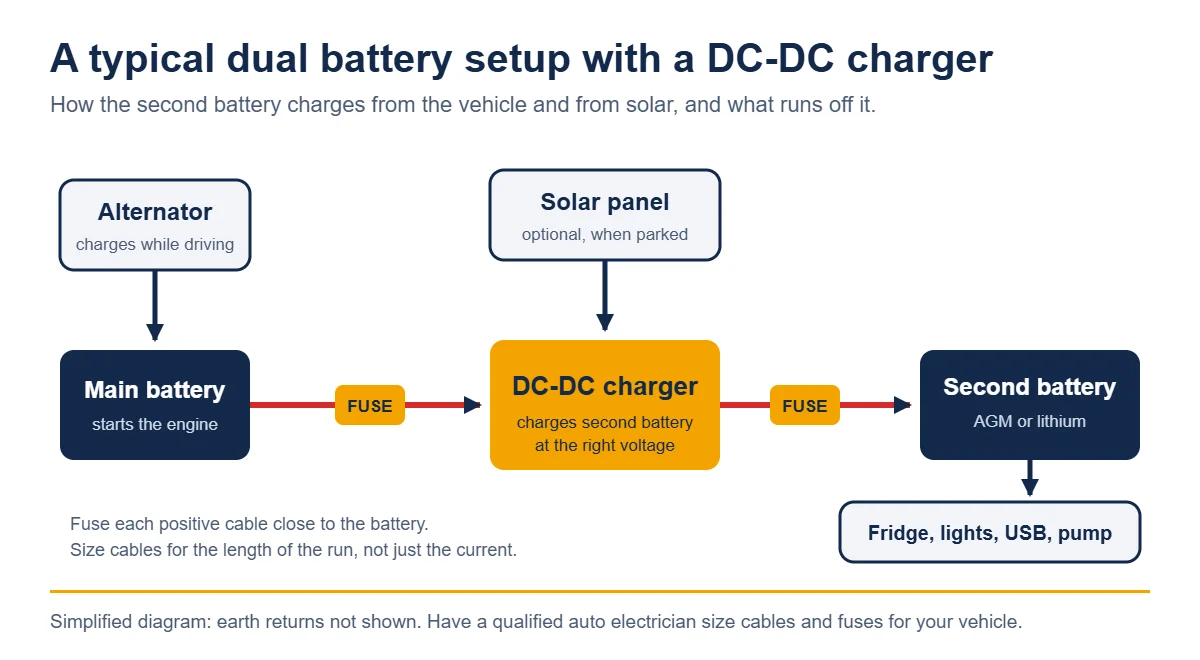
The system charges the auxiliary battery from the alternator while you drive, and often from solar when you're parked. Our guide on how a dual battery system works explains the basics.
Advertisement
DC-DC charger or isolator for outback trips
A simple voltage-sensitive isolator joins the two batteries when the engine is running and separates them when it's off. It's cheap and simple, but it can only pass on whatever voltage the alternator provides. Many recent 4WDs have smart alternators that lower their voltage once the starting battery is full, so an isolator may leave the auxiliary battery undercharged.
A DC-DC charger manages the charge itself, with a proper multi-stage profile, and most models also take solar input. That suits outback trips, where you might drive for half a day and then sit at camp for two. It also suits lithium auxiliary batteries, which generally need a charger with the right profile. Read DC-DC charger or isolator to compare them.
Where to put the auxiliary battery
Many 4WDs have room for a second battery under the bonnet, and it's the shortest cable run. But the engine bay in outback summer heat is a tough place for a battery. Heat shortens the life of lead-acid batteries, and lithium batteries have temperature limits for charging that their management system will enforce by cutting back or stopping the charge.
Mounting the auxiliary battery in the rear, in a canopy, drawer system or tray, keeps it cooler and frees up the engine bay. The trade-off is a longer cable from the front, which needs to be thicker to avoid voltage drop. A DC-DC charger mounted near the rear battery handles the long run well. Whatever you choose, the battery needs a solid, rated hold-down; a battery loose on corrugations is a serious hazard.
Wiring that survives corrugations and dust
Most outback electrical failures are not dead components. They're connections that have shaken loose, chafed through or filled with dust. These details make a big difference:
- Size every cable for its current and length. Undersized cable runs hot and wastes charge. Our 12V cable size guide helps.
- Fuse both ends of any cable that runs between two batteries, close to each battery. See where to put the fuse.
- Use quality crimped lugs, not twisted wire or cheap terminals, and support the cable near each lug so vibration doesn't fatigue it.
- Use grommets wherever cable passes through metal, and clip cable every short distance so it can't move and chafe.
- Choose dust-sealed plugs and switches, and fit dust caps to Anderson plugs and accessory sockets.
- Check battery terminals and hold-downs after the first day of rough road, then every day or two.
Fridges, solar and power budgets
The fridge is usually the biggest load in an outback setup, and it works hardest in hot weather. Work out roughly how much power your fridge and other gear use in a day, then check your battery capacity and charging can cover it, including days when you don't drive. Portable or roof-mounted solar keeps the auxiliary battery topped up on rest days.
Keep the fridge well ventilated, out of direct sun where you can, and away from the hottest parts of the vehicle. A fridge in a closed, baking canopy will run almost non-stop and drain the battery much faster.
Spares, tools and checks before you leave Adelaide
Take a small electrical kit that lets you fix the common faults yourself, and know how to use it before you need to. A cheap multimeter is the most useful tool in it.
- Fuses in every rating used in your vehicle and accessories, plus spare midi or ANL fuses for the dual battery circuit.
- A few crimp lugs and connectors, a crimper, heat-shrink, electrical tape and cable ties.
- A short length of heavy cable with lugs, to bypass a damaged battery cable in an emergency.
- A jump starter or jumper leads. See how to jump-start a car safely.
- Before leaving, have both batteries load-tested and the alternator output checked, especially if the batteries have been through a few Adelaide summers.
Getting the setup right before the trip
If you're adding a dual battery system, do it a few weeks before you leave, and use it on a weekend trip first so any problems show up close to home. Remote travel also calls for good communications and safety gear, such as a UHF radio and a personal locator beacon, so plan the power for those too. Auto electricians in the Northern Suburbs and around Regency Park on the way out of town fit plenty of 4WD setups.
Parts for this job
Order quality parts online from Ozautoelectrics, dispatched Australia-wide.
Get it done: get a quoteDo it yourself: shop DC-DC chargers
Get it done: get a quoteDo it yourself: shop dual battery kits
Get it done: get a quoteDo it yourself: shop Anderson plugs
Get it done: get a quoteDo it yourself: shop battery cables
Questions Adelaide drivers ask
Do I need a DC-DC charger for outback trips from Adelaide?
Not always, but it's usually the better choice. If your 4WD has a smart alternator, or you're running a lithium auxiliary battery or adding solar, a DC-DC charger will charge the second battery more fully and more safely than a basic isolator. For an older vehicle with a conventional alternator and a lead-acid auxiliary battery, an isolator can still work.
Should my second battery go under the bonnet or in the back?
Under the bonnet gives the shortest cable run, but heat shortens battery life and can limit charging of lithium batteries. Mounting it in a canopy or drawer system keeps it cooler, but needs thicker cable for the longer run, ideally with the DC-DC charger near the battery. Either way, use a strong, rated hold-down.
What electrical spares should I carry on the Oodnadatta Track?
Carry spare fuses of every rating you use, including the large fuses on the dual battery circuit, plus crimp lugs, a crimper, heat-shrink, tape, cable ties, a multimeter and a jump starter or leads. A short emergency battery cable with lugs fitted is also handy. Know how to use everything before you go, because help may be hours away.
Need an auto electrician in Adelaide?
Find local auto electricians and mobile services in the Adelaide directory, or start with your area: Northern Suburbs, Inner West and Port, Southern Suburbs, Eastern Suburbs.
Search auto electrical parts
Searches the full range at Ozautoelectrics, opening in a new tab. Popular: dual battery · LED light bars · trailer plugs · fuses
Run an auto electrical business in Outback 4WD and Dual Battery Setups from Adelaide?
- New to Ozautoelectrics? Apply for trade pricing on quality auto electrical parts.
- Already a trade customer? Log in and order parts at your trade price.
- Want more local customers? List your business on this site so drivers in Outback 4WD and Dual Battery Setups from Adelaide can find you.
Not confident doing this yourself?
There’s no shame in handing it over. A local auto electrician can diagnose the fault properly and get it done safely, especially for anything involving brakes, airbags, hybrid systems or air-con gas.
Get a quote from a local auto electrician Or shop the parts and do it yourself